Farm Gate vs Wholesale
The price a farmer gets at the farm gate and the price a consumer pays in town are linked by transport, handling, losses and trader margins.
When a West African farmer sells produce at the farm gate, what does that price actually mean, and how does it compare with wholesale and retail prices? The answer starts with three price points.
- Farm gate price: FAO defines producer prices as prices received by farmers "at the farm gate" or at the first point of sale, when farmers sell their own products. Transport and later marketing costs are not included.
- Wholesale price: the price at which traders sell in bulk to retailers, processors and other buyers, after the produce has been moved, handled and often stored.
- Retail price: what the consumer pays, covering the retailer's costs of repackaging into small quantities, storage and transport, plus a margin.
What sits between the prices
Between the farm and the consumer, each step adds costs: loading and transport, market levies, storage, repackaging, the cost of credit and the trader's margin. Losses are a cost too. Whatever spoils on the way has to be paid for by the produce that is sold.
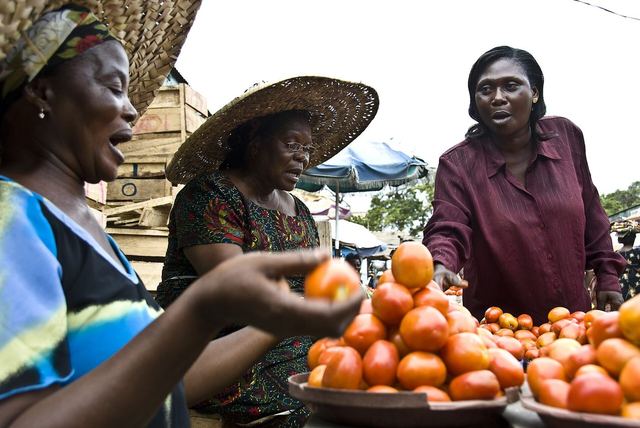
Tomatoes show why the gap can be wide for perishables. A 2020 market brief by Ghana's Ministry of Food and Agriculture (MoFA) and the International Food Policy Research Institute (IFPRI) cites estimates that post-harvest handling, transport, storage and processing losses of tomato range from 20 to 65 percent of production. The brief describes traders, mostly women known as "market queens", as the link between farms and urban markets and as the actors capturing the largest share of the margin. Seasonality adds risk: in its analysis, prices were lowest around September and tended to be almost double that low by May.
What the published data show
The same MoFA–IFPRI briefs compared national wholesale and retail prices collected by MoFA's Statistics, Research and Information Directorate (SRID). For tomato between 2009 and 2019, retail prices were on average 12 percent higher than wholesale prices. For maize, the retail markup over wholesale was around 20 percent between 2008 and 2016 and averaged more than 40 percent in 2017–2019, while real wholesale prices fell. These figures describe the wholesale-to-retail step only; the farm gate share varies by crop, place and season and is not captured by a single national number.
How a farmer can use published prices
Official and development-agency sources publish market prices that can serve as a reference point. In Ghana, SRID collects wholesale and retail prices for major markets; across the region, FEWS NET and FAO's Food Price Monitoring and Analysis tool publish prices for selected markets, often compared with the previous year and the five-year average.
To use them in a negotiation:
- Compare like with like: the same commodity, unit, quality and a market that buyers in your area actually supply.
- Subtract a realistic cost of getting the produce there: transport, loading, levies and the losses you would carry.
- Check the season: a price published at the peak of the lean season will not hold at harvest.
- Treat the result as a floor for discussion, not a guaranteed price. Farmer groups that sell together can also share transport costs and bargain with larger volumes.
A wide gap between farm gate and retail prices does not always mean a farmer is being cheated, but a gap much wider than the real costs of moving and storing the produce is a good reason to ask questions or look for another buyer.